
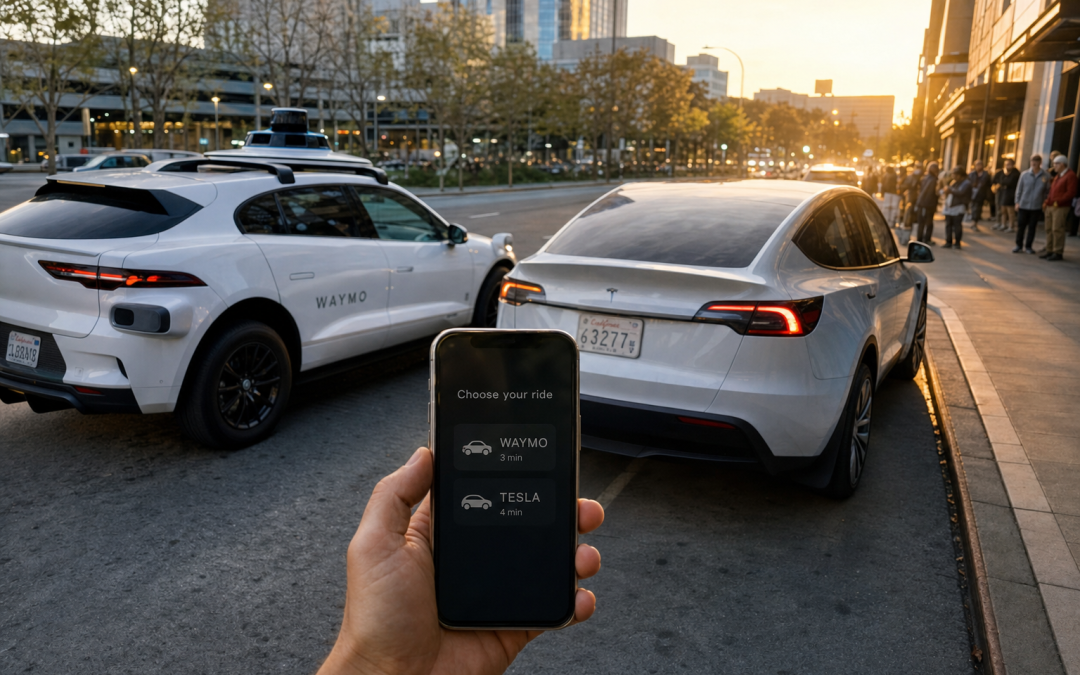
Robotaxi 2026 is not just a mobility story. It is a scale story, a margin story, and a data story. Waymo and Tesla are racing toward the same prize from radically different angles, and the real question is simple: who can deliver safe rides, at lower unit cost, across more cities, faster? That answer will shape transport, logistics, and AI-led business models far beyond cars.
Why robotaxi scale will decide the winner
Scale decides this market.
The winner in robotaxis will not be the company with the loudest launch, the slickest demo, or the boldest promise. It will be the one that can turn autonomy into margin. That is the real frame for Robotaxi 2026 Waymo Tesla and the Economics of Scale, a fight shaped by cost discipline, operational repeatability, and how fast each player can spread fixed spend across paying rides.
The levers are brutally simple:
- cost per mile, because cheap rides beat clever narratives
- fleet utilisation, because idle vehicles do not compound
- downtime and maintenance, because dead hours kill revenue
- insurance and safety costs, because risk always lands on the P&L
- mapping and compute costs, because intelligence is expensive before it gets cheap
- customer acquisition and retention, because empty seats burn cash
- regulatory expansion speed, because delayed market entry delays payback
This is where scale gets almost unfair. Software, training, remote support, depot systems, compliance teams, all of it costs a fortune upfront. Spread those costs across a few hundred cars and the model looks fragile. Spread them across tens of thousands of vehicles and the economics start to bend in your favour. A flashy autonomous drive can impress. A profitable transport network must absorb mistakes, keep cars moving, and still protect margin. Those are very different games.
Waymo is building a tightly controlled system, sensor-heavy, city by city, with deep operational oversight. Tesla is chasing a different prize, a vision-first model built around installed fleet advantage and lower hardware cost per vehicle. I think that tension matters more than people admit. It is a bit like from demo to P&L, the monetisation reckoning hitting GenAI products, where technical proof means little until the unit economics hold.
And that is the hinge into what comes next. The business only works if safety, servicing, dispatch, and exception handling can be industrialised, not admired from a distance.
Waymo and Tesla are solving different problems
Waymo and Tesla are solving different problems.
That matters more than most commentary admits. People compare them as if both are selling the same robotaxi product, through the same route to market. They are not. Waymo is building a tightly controlled transport service. Tesla is chasing a generalised autonomy stack that can spread across a huge installed base. Similar headline, very different game.
Waymo’s edge starts with hardware and discipline. Its sensor stack gives rich environmental certainty. That supports precise behaviour in geofenced areas, with mapped streets, managed operations, and supervised rollout logic. It is slower, yes, but slower with intent. Every expansion is operational, not just technical. That tends to help with regulator comfort and early customer trust.
Tesla is taking the opposite bet. Cameras first, software first, scale first. The thesis is brutally simple. If vision can solve driving well enough, lower hardware cost unlocks wider deployment. Then the real weapon is fleet data. Millions of real-world miles feed training loops, expose edge cases, and sharpen models at a pace few can match. I think that is the attraction investors keep paying for.
The trade-off is obvious, but not neat. Waymo can deliver precision in tighter domains, yet that precision carries heavier hardware and operating costs. Tesla can, perhaps, spread faster across wider domains, but only if intervention rates, safety performance, and policy friction stay under control.
So the real commercial question is this, which system moves from pilot success to citywide profitability without blowing out cost structures?
Data flywheels decide more than branding does. Better data improves training. Better training reduces rare failure modes. Better real-world outcomes improve trust, approvals, and demand. But data alone is not enough. The winners pair smart models with repeatable operations and measurable ROI, much like firms using practical automation, guided learning, and no-code tools such as master AI and automation for growth instead of waiting for perfect conditions. Next comes the harder issue, deployment economics and infrastructure.
The real battleground is cost per mile
The real fight is cost per mile.
That is the scoreboard. Not viral clips, not launch theatre, not valuation stories. If a robotaxi cannot deliver low cost per mile at reliable utilisation, it does not scale, it burns cash with style.
Start with the cost stack. Vehicle hardware and depreciation sit at the front. Then sensor and compute spend. Then the monster most people forget, software development and model training. Add remote assistance, operations staff, charging, cleaning, servicing, repairs, insurance, liability, compliance, and the hidden tax of fleet dispatch. Miss one line item and your model looks brilliant on paper, then ugly in the street.
- Cheap hardware helps, but only if intervention rates stay low
- Safer systems help, but only if vehicle cost does not crush payback
- High utilisation matters more than technical theatre
Waymo and Tesla are attacking this from opposite ends. Waymo appears willing to carry higher hardware cost for stronger performance in defined zones. That can work beautifully on dense urban routes, airport runs, and commuter corridors where cars stay busy. Tesla is chasing a lighter hardware bill and broader reach. Great, if software can suppress edge case failure and keep remote support lean. If not, the savings disappear into human oversight and lower trust.
Utilisation density changes everything. A robotaxi idle in a weak suburb is dead capital. A robotaxi circulating through repeatable, high-demand corridors compounds returns. City-by-city rollout can sharpen economics when route patterns are predictable. It can also constrain them when each new city needs heavy operational tuning.
I think this is the business lesson too. AI scale comes from systems, not scattered tools. Firms building repeatable gains with step-by-step tutorials, AI assistants, proven automations, and ready-built workflows on platforms like the future of workflows, Make.com, and n8n tend to compound faster. 2026 will reward the operators who pair autonomy with disciplined execution.
What Robotaxi 2026 means for business and investors
2026 will separate the real operators from the theatre.
For passengers, robotaxis promise convenience. For business leaders, they signal something bigger, margin built by software that keeps getting better after deployment. That is the prize. Investors should stop chasing glossy demos and start watching the scoreboard. Not the story, the scoreboard.
What matters? A handful of signals, and they are brutally practical.
- Safety performance at scale, because low incident rates create trust and lower insurance pressure.
- Expansion into new cities, because a model that works in one zone may break in the next.
- Regulatory momentum, because permission is part of the product.
- Ride pricing versus human-driven alternatives, because demand follows value.
- Fleet utilisation rates, because parked vehicles do not print margin.
- Capital efficiency, because growth funded by endless cash is not a business.
- Public trust and repeat usage, because habit is where enterprise value hardens.
This matters to insurers, logistics firms, founders, fleet operators, everyone. The winner will probably not be the company with the flashiest autonomy moment. It will be the one that turns autonomy into a repeatable operating system, city after city, vehicle after vehicle, shift after shift. That is less glamorous. It is also where fortunes get made.
The same lesson applies inside your company. AI does not create an edge because you bought access. It creates an edge when it is wired into better workflows, lower labour drag, faster decisions, and fewer dropped balls. I have seen firms chase tools and still stay stuck. Then one team builds clear systems with premium prompts, templates, custom no-code AI agents, and the right peer support, and things start moving. Fast.
If you want a practical example, master AI and automation for growth is the sort of thinking worth studying.
Want to build AI driven automation that cuts costs, saves time, and gives your business a serious edge? Book a call with Alex here: https://www.alexsmale.com/contact-alex/
2026 will reward execution. The companies that systemise AI will not just keep up, they will quietly pull away.
Final words
Robotaxi 2026 will be decided by one brutal truth: scale only matters when it lowers cost, improves safety, and strengthens trust. Waymo and Tesla bring different weapons to the fight, but the winner will be the one that turns autonomy into repeatable profit. For business leaders, the lesson is bigger than transport: AI wins when it is operationalized, automated, and deployed with discipline.