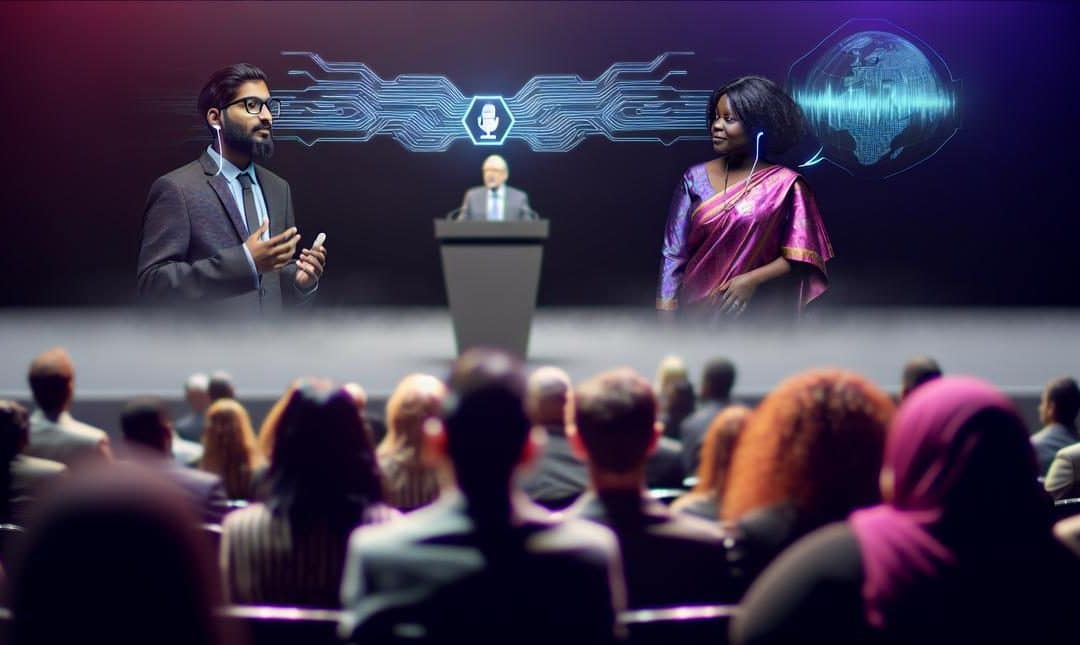
Real-time voice translation is revolutionizing live events, offering opportunities for inclusive global communication. Explore the tech behind it, challenges like latency, and its impact on stagecraft in this article.
The Evolution of Real-Time Voice Translation
Real time voice translation did not arrive overnight.
Early attempts were clunky. Rule based engines stitched dictionaries into stiff sentences, while speech recognition stumbled on accents. On stage, that lag killed timing. Human interpreters still owned the pit, quick and trusted.
The 2000s shifted gears. Phrase based statistical systems learned from corpora, then stalled on idioms and jokes. Latency shrank a little, crowds wanted more. The real break came with deep learning. Sequence to sequence models learned context, attention let systems hold a thought. Transformers scaled that learning. In parallel, streaming speech models cut word error rates on noisy mics. You could aim for sub second segments, not minute chunks. Not perfect, but close enough for applause gaps.
Proof arrived in the wild. Skype Translator made the idea feel possible, even when it tripped on names. I tested an early build backstage once, it corrected itself mid sentence. Researchers like Hinton and Vaswani set the pace, event teams made it survive feedback loops.
For a wider view of live dubbing’s rise, see Multilingual live dubbing, how AI is making every creator global by default. The tools matured, perhaps unevenly. I think producers did too.
Technology Behind the Translation
Real-time voice translation runs on a four step pipeline.
First, automatic speech recognition listens, cleans the audio, and turns phonemes into text. End to end models, think Conformer or RNN-T, handle accents, crosstalk, and loud rooms. Voice activity detection trims silence. Speaker diarisation stops panel sessions turning into soup.
Next comes translation. Transformer based neural machine translation maps intent, not only words. Domain tuned glossaries stop brand names drifting. Streaming decoders push partial sentences forward, perhaps a touch early, so presenters do not wait.
Then text to speech. Neural vocoders shape a clear voice, preserve rhythm, and keep emphasis. Some teams use a light voice clone, others keep a neutral house voice for clarity. I have heard both work. I think prosody transfer wins on stagecraft.
Finally, orchestration makes it play nicely with the rig. Low latency audio buffers, packet loss fixes, and content filters route clean feeds to IFB, web, and overflow rooms. Toolkits like NVIDIA Riva help engineers fit this into Dante based setups without drama.
For tight rooms or privacy, on device models are rising fast, see On-device Whisperers, building private low latency voice AI that works offline.
One note, speed still decides trust. We will get to that next.
Tackling Latency Challenges
Latency breaks the spell.
When a speaker pauses and the translation lands late, the room disconnects. Jokes miss, panels drift, music cues lose bite. I have seen a standing ovation stall because subtitles lagged. It felt avoidable.
The fix starts before showtime, with a strict latency budget per segment. Split it, capture, translate, speak, display. Then shave everywhere. Use streaming decoders with partial hypotheses, predictive turn endings, and wait k strategies that trade tiny accuracy for speed. Run low bitrate, high quality codecs like Opus. Pick an engine shaped for streaming, for example NVIDIA Riva, set to aggressive endpointing.
Pipelines must stay lean. No cold starts, no extra hops. Move processing closer to the mic, sometimes on device. Preload domain terms, cache voices, pin threads to cores. Watch jitter, not just averages. Perceived speed lives near 200 ms, see latency as UX, why 200ms matters for perceived intelligence. I think that threshold keeps trust intact.
Small habits help:
– Use wired networks, with QoS for audio
– Keep micro batches tiny, perhaps zero
Perfection is rare. With a lean chain and a steady backbone, the audience hears now, not later.
Integration into Stagecraft
Real-time translation belongs in the show.
Fold it into cue stacks, mic routing, and screen content. Treat it like lighting, with presets and failsafes. The audience should feel guided, not managing tech. Clear language selection on entry, a quick QR, simple icons on screens, done.
At seat level, phones can be the headset. Sennheiser MobileConnect pipes language channels to personal devices, keeping aisles tidy and budgets saner. Captions ride the IMAG or side screens, timed to stage cues. For context, see multilingual live dubbing, how AI is making every creator global by default. Different format, same promise, more people lean in.
This works across formats. Conferences use backstage talkback so interpreters get slide change calls. Panels need mic flags mapped to language models, plus quick reassigns when chairs swap, it happens. Concerts prefer minimal onstage clutter, so captions hit LEDs and fans choose audio on mobile. Awards nights add a glossary pass for names and sponsors, pre-show, then lock it.
The crew matters. The **showcaller**, FOH, video, and language lead share a single cue sheet. AI helps glue it. Auto speaker ID switches channels, glossary enforcement protects brand terms, and real-time quality alerts nudge humans before problems spread. I think this saves hours in rehearsal. I once saw it cut a full tech run by half, perhaps luck, yet the crowd heard every word.
Leveraging AI Expertise for Future Events
AI expertise turns messy event plans into predictable outcomes.
An experienced consultant becomes your translator of the tech itself. They map outcomes to tools, set a latency budget per format, and choose speech capture, translation, and voice synthesis that suit the room, not just the spec sheet. They prepare glossaries, tone guides, and speaker bios so models stop guessing. Then they connect scheduling, content ingestion, and QA loops that run while you sleep. It sounds simple, I think, yet the gains stack fast.
To keep costs down, they cut reruns. Cache repeated phrases. Pre ingest scripts and slide decks. Push small rooms to on device models, reserve cloud for plenary peaks. Consolidate vendors where sensible. A single control pane beats five invoices. If you need a packaged layer for hybrid events, KUDO is a fair benchmark, although not the only path.
Learning changes the game. A good partner brings short playbooks, office hours, and a private channel for war stories. Share the wins, and the messy bits. You can start with this primer on Real-time voice agents, speech to speech interface, then pressure test your stack.
Access to tailored automation comes next. A mini discovery, a rapid pilot, live metrics, and tweaks per room. Perhaps imperfect at first. Then, week by week, better.
Conclusion and Call to Action
Real time voice translation is now stage ready.
Across arenas, expos, and boardrooms, it closes the language gap without closing the energy in the room. You keep the pace, the punchlines, the signals to crew. The audience stays with you, in their language, near live. I have seen shy delegates lean in when captions snap into sync. Small thing, big lift.
The tech is here, and it is practical. The trick is latency discipline and showcraft. Your mics, IFB, confidence monitors, and cueing need a plan. Sub 300 ms changes how people feel the show. If you want a primer, read Latency as UX, why 200ms matters. It matters more on a stage than on a laptop.
One example, tools like KUDO can cover languages fast, while you protect brand tone with glossaries and style.
- Grow international reach without duplicating shows or speakers.
- Scale language coverage without scaling crew and chaos.
- Keep delivery natural, your voice, your timing, your story.
If you want this handled without guesswork, connect with specialists who have shipped it, not just demoed it. Perhaps you want a quick audit, or a custom runbook. Either way, ask for a practical plan that fits your venue, your kit, your budget.
For a personalised blueprint and hands on rollout, start here, talk to Alex. Let us map your next live event to real results.
Final words
Real-time voice translation holds transformative potential for live events. As technology evolves, event planners can harness these tools to enhance communication and engagement. By leveraging AI expertise, businesses can optimize their processes, reduce costs, and deliver superior audience experiences. Connect with experts to explore custom solutions and future-proof your event strategies.