
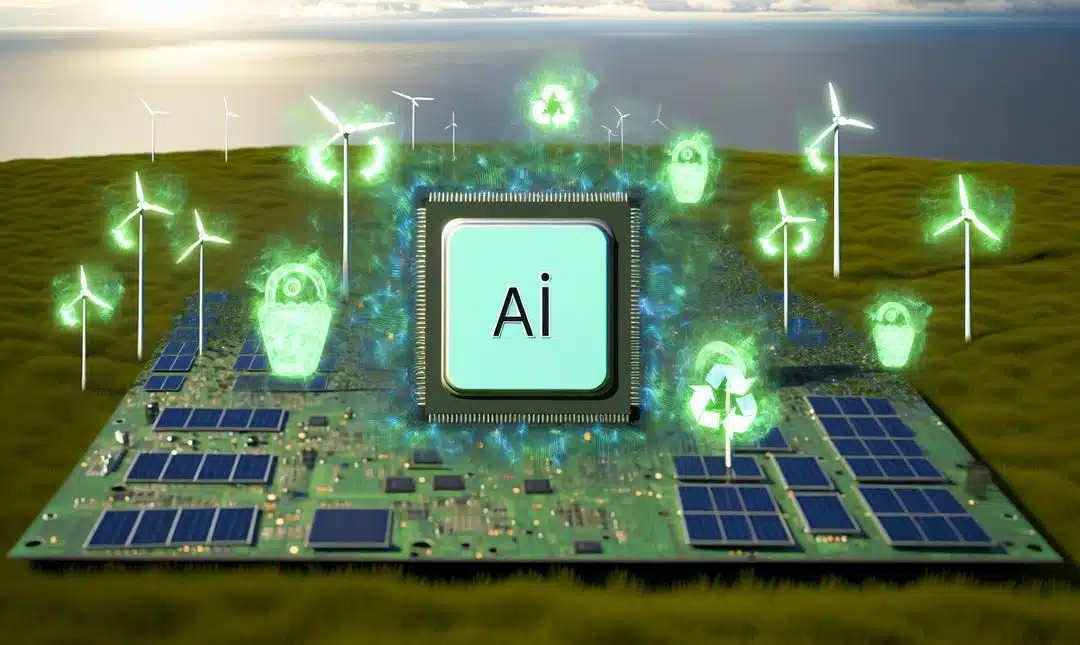
Green AI is changing the landscape of technology by focusing on eco-friendly practices. Discover how measuring and reducing inference energy can enhance efficiency and sustainability while cutting operational costs. Dive into the future with AI-driven automation that empowers businesses to save time, streamline operations, and stay ahead of the curve.
The Importance of Green AI
Green AI is about outcomes that respect the planet.
I see the surge in model use every week, and the meter keeps ticking. Green AI means designing, deploying, and scaling AI with energy and carbon as first class constraints. It covers model size choices, hardware selection, job scheduling, caching, and, crucially, the energy drawn each time a model answers a prompt. That last part, inference, is where costs and carbon quietly pile up.
A quick back of the envelope. A single GPU at 300 watts serving 50 tokens per second draws about 6 watt seconds per token, roughly 0.0017 Wh. A 1,000 token answer is near 1.7 Wh. Now multiply. 100,000 daily answers, about 170 kWh. With a grid at 300 g CO2 per kWh, that is around 51 kg CO2 per day. The numbers vary by hardware and code paths, I think they often surprise teams.
Why this matters is simple,
– Cost, lower energy per answer, lower bill, scale with margin
– Carbon, fewer grams per query, cleaner growth
– Performance, leaner loads can cut latency too, a nice bonus
There is a commercial angle as well. Inference that wastes energy also wastes money. See the practical case in The cost of intelligence, inference economics in the Blackwell era. Perhaps a touch blunt, but true.
Balance matters. Push model quality, yes, yet cap the energy curve with smart choices. Measuring inference energy is the lever that makes that balance real.
Measuring Inference Energy
Measurement comes before savings.
Start by choosing a boundary. Measure the model, the host, or the whole service. Then choose a unit. I like Joules per inference, Joules per token, and watts at idle vs load.
Next, watch the right counters. On CPUs, RAPL gives socket power. On GPUs, nvidia-smi exposes draw, clocks, and utilisation. Smart PDUs or inline meters validate the numbers, because software can drift. Cloud teams, map energy to region carbon intensity, grams CO2 per kWh, not just power.
Tools matter, but habits matter more. Log energy with latency. CodeCarbon tags runs with energy and location, so trends jump out. I think alerts on sudden Joule spikes help keep changes honest.
What shows up when you measure is often surprising. One ecommerce search team found cold start storms were the real culprit, they cut idle waste by 23 percent. A fintech LLM gateway trimmed tail power by sampling at 1 Hz, not 10, odd, but true. For unit cost context, read The cost of intelligence and inference economics in the Blackwell era.
These numbers set up the next step, changing model and stack.
Strategies to Reduce Inference Energy
Cutting inference energy starts with the model.
Start by making the model smaller without losing what matters. Distillation moves knowledge into a lighter student, often with surprising resilience. Pair it with pruning and structured sparsity, then test early exit heads for tasks that do not need the full stack. If you want a practical primer, this guide on model distillation, shrinking giants into fast focused runtimes is a strong place to begin. I have seen teams ship the student and forget the teacher, on purpose.
Reduce the math. Quantisation to int8 or fp8 lowers power draw, often by double digit percentages. Calibrate with a representative set, per channel when possible, then try QAT for spiky domains. Graph compile the path, NVIDIA TensorRT style, to fuse kernels and cut memory traffic. A single flag sometimes drops watts, which still feels strange.
Tune the serve path. Use dynamic batching, KV cache reuse, and speculative decoding for token heavy work. Trim context, or move to retrieval, so you send fewer tokens in the first place. Choose the right silicon for the shape of your traffic, GPUs for bursts, NPUs or custom chips for steady loads. Co locate where data lives to curb I O. And if traffic is spiky, consider serverless scale to avoid idling machines, we will pick that up next.
AI Automation Tools for Sustainability
Automation changes sustainability results.
Green AI is not only model tweaks, it is turning routine chores into event driven flows. The right tools cut clicks, idle compute, and avoid rework. Fewer handoffs means fewer calls to models. Smart triggers batch low value tasks and pause heavy jobs during peaks. I have seen teams breathe when queues stay short.
- Reduce manual processes: auto triage, dedupe leads, reconcile entries. Each skipped click saves watts and time.
- Boost campaign effectiveness: segment freshness scoring, send time tuning, creative rotation guided by uplift. Fewer wasted impressions, lower inference calls, cleaner spend.
- Streamline workflows: routing with clear SLAs, lightweight approvals, caching frequent answers. Less back and forth, fewer retries, smaller data transfers.
For a simple start, see 3 great ways to use Zapier automations to beef up your business and make it more profitable. When stitched with your CRM and ad platforms, you cut background polling and redundant API calls. Schedule heavy analytics overnight, use event hooks, not five minute polls. On one client, a small change cut API chatter by 28 percent. Perhaps the exact figure is less important, the trend matters.
These gains need habits, not just tools. Document triggers, prune rules monthly, and watch the queues. These gains stick when teams share playbooks and keep learning, I think that is next.
Community and Learning Opportunities
Community makes Green AI practical.
People learn faster together. A private circle of owners and engineers shortens the gap between theory and watt savings. You get real answers on measuring energy per request, not vague chatter. I like step by step tutorials for this exact reason, they turn ideas into action. If you prefer guided examples, try How to automate admin tasks using AI, step by step. Different topic, same rhythm of learning you can apply to measuring and reducing inference energy.
Collaboration sparks better decisions on the small things that move the needle. Batch sizes. Quantisation. Token limits. Caching. Even model routing. One owner’s test can save you a month. I have seen a simple change to logging cut power draw by 12 percent. Not huge, but very real.
Inside a focused community, you get:
- Clear playbooks for tracking watts per call and cost per response.
- Practical workshops on profiling, batching, and right sizing models.
- Peer reviews that flag idle GPU time and wasteful retries.
- Office hours to sanity check settings before you scale spend.
We talk tools too, lightly. Hugging Face is common, though not the only path. I prefer what works, not what trends. The next section moves from community learning to rolling this into your operation, step by step. Perhaps you are ready to make it concrete.
Implementing Green AI in Your Business
Green AI belongs in your profit plan.
Start with a clear baseline. Track joules per request, CO2e per session, cost per thousand inferences, and P95 latency. Tie each metric to a business outcome, lower power draw, faster journeys, fewer drop offs. For a quick primer on money and model choices, read The cost of intelligence, inference economics.
Then bring it into real workflows. Marketing first, trim hallucination retries, cache top prompts, pre create assets during off peak windows. Product next, distil your largest model to a small one for 80 percent of requests, route edge cases to the bigger model. Support last, batch similar intents and cut token budgets, perhaps more than feels comfortable at first. I have seen teams halve compute with no loss in satisfaction.
A simple rollout I like:
- Right size, choose the smallest model that still hits your KPI.
- Quantise, go to 8 bit or 4 bit with ONNX Runtime.
- Cut repeats, cache embeddings, share results across sessions.
- Move closer, push inference to device or edge when privacy allows.
If you want a tailored plan for your funnel, pricing, or product stack, book a short call. I think the fastest route is a custom audit with automation baked in. Ask for your personalised strategy here, contact Alex.
Final words
Green AI represents an essential step toward sustainable technology practices. By reducing inference energy, not only can businesses cut costs and save time, but they can also enhance environmental sustainability. Embrace AI-driven solutions to future-proof operations and secure a competitive advantage. Contact our expert for personalized AI automation strategies that align with your goals.